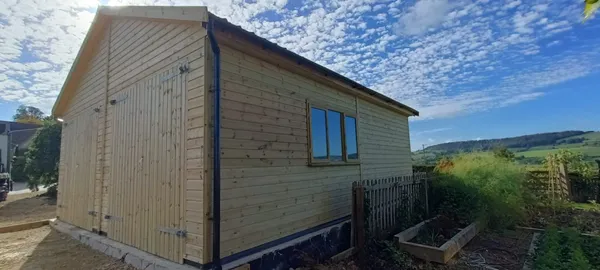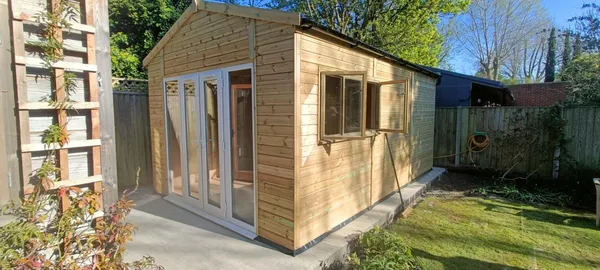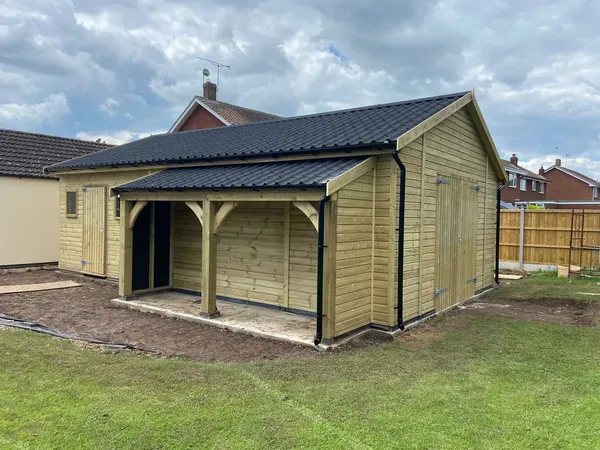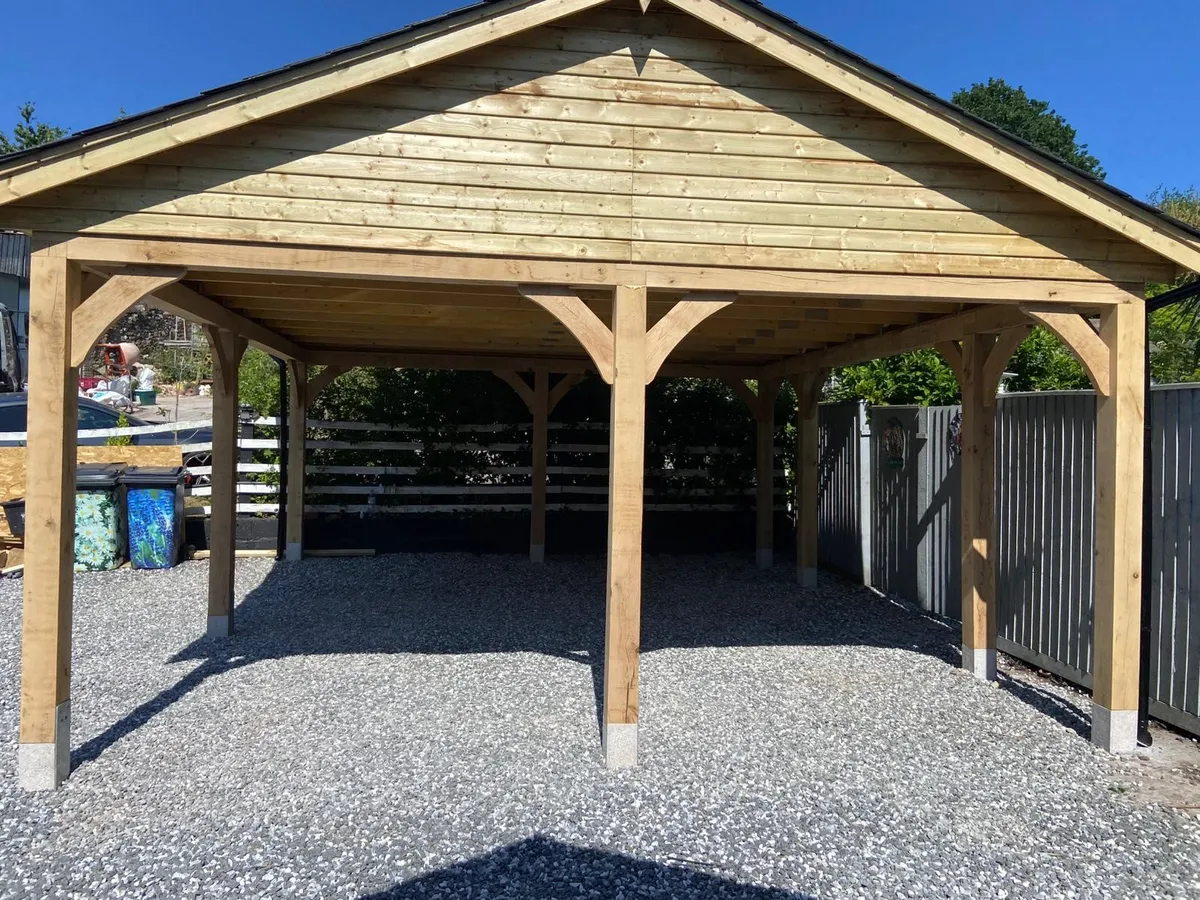
Start with the property and how you plan to use the carport. The design should provide practical parking without looking too large or out of place beside the house.
You do not need to copy every feature of your home. A few well-chosen details can create a clear connection between the two buildings.
Below, we explain each of these carport design choices in more detail.
Carport designs range from traditional timber structures with pitched roofs and exposed framing to simpler, more contemporary options. Choose the style that works best with your home and how visible the carport will be.
The roof often creates the strongest connection with the house. A similar shape, pitch or covering can help the two buildings look as though they belong together.
A made-to-order carport gives you more control over the size, roof and details. You can adjust the design to suit your property, vehicles and available space.
For more ideas, read our guide to making a detached garage look like part of your property.
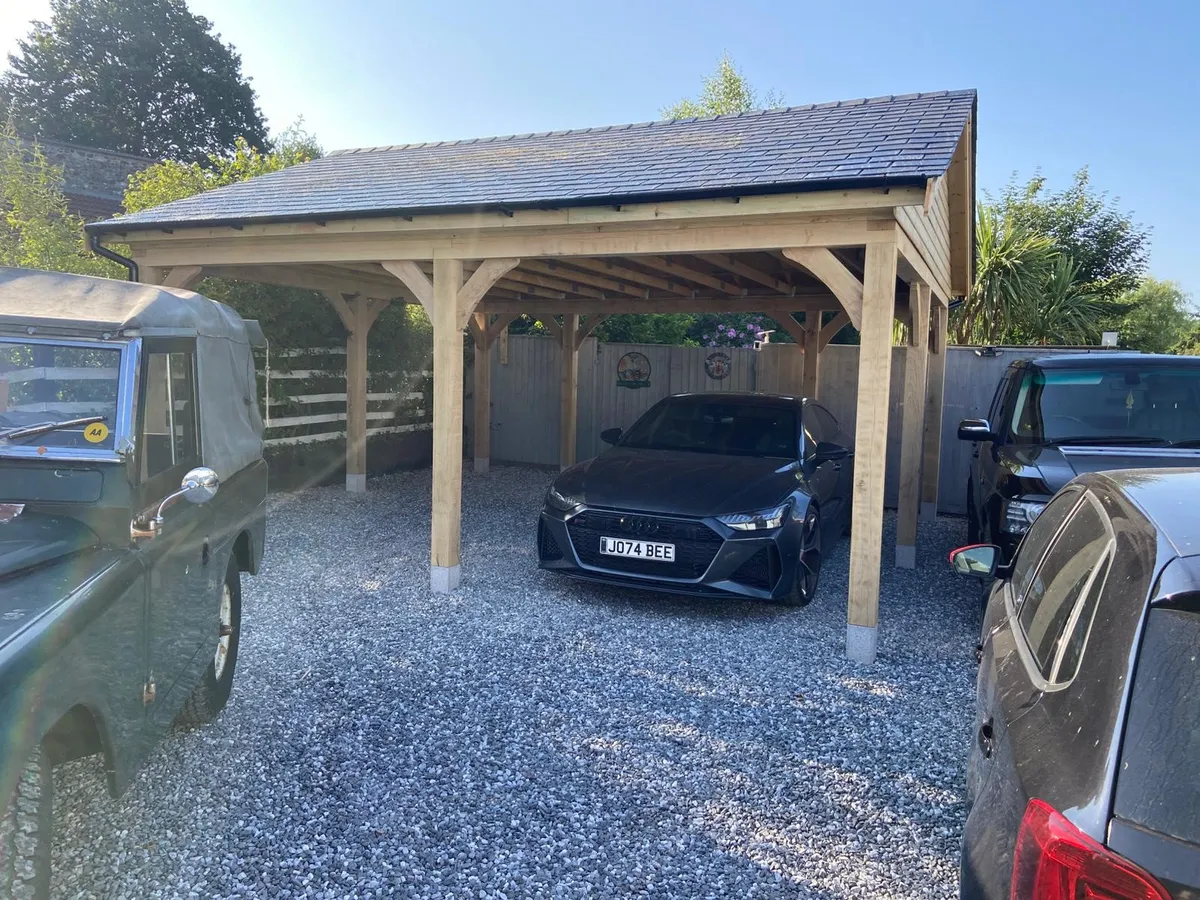
Timber can suit a wide range of town and country properties. Its natural appearance works well beside both traditional and modern homes.
You can adapt the size, roof shape and details to suit the plot and keep the carport in proportion with the house. Timber also has a warmer, less industrial appearance than metal.
A well-built timber carport can provide durable, year-round shelter from rain, hail and sunlight without the bulk of a fully enclosed garage. Its long-term performance will depend on the timber, design, installation and maintenance.
Size is one of the main factors that affect how a carport looks and works. It needs to be large enough to use comfortably, but not so big that it overwhelms the house.
Start with the basics. How many vehicles need to fit under it? Will you need space to store items such as bikes or firewood? These factors will affect the width, depth and overall layout. Remember to allow enough room to open doors and move around easily.
Check the height of your vehicles, including roof bars or roof boxes. A carport that is too tall can feel out of place, especially next to a lower house. Keeping it slightly lower than the main building usually helps it fit in better.
Where the carport sits on your plot will affect how it looks and how easy it is to use.
Placing it close to the house can make access easier and help the structure feel connected to the main building. However, the best position will also depend on the driveway, ground conditions, drainage and available space.
Consider vehicle access and movement early on. Leave enough room to approach, park and leave without tight turns or awkward manoeuvres. This can be more difficult on a smaller plot.
Also think about how visible the carport will be. A carport at the front will be more noticeable and may need planning permission.
Boundaries can also affect the position. Leave space for maintenance where possible, and keep the roof, gutters and posts within your property.
For more help, read our guide to choosing the best garage placement on your property.
In England, you may be able to build a carport without applying for planning permission if it meets permitted development rules.
The carport must be single-storey and must not sit in front of the main wall at the front of your house. The eaves must be no higher than 2.5m. If any part sits within 2m of a boundary, the whole structure must also be no higher than 2.5m. Size and ground-coverage limits apply
Extra restrictions may affect listed homes and properties in conservation areas, National Landscapes or other protected locations.
Check the rules with your Local Planning Authority. You can also read our guide to planning permission for garages, carports and carriage houses.
At Chart Garages, our timber carports are made to order. You can choose from different sizes, layouts and details to suit your property and how you plan to use the space.
Options include single or multiple bays, walls between bays and partial enclosure on one or two sides.
Roof coverings include Tapco synthetic slate, Onduline sheets, Onduvilla tiles and cedar shingles. Choose an option that works with the carport design and your home. You can compare these materials in our guide to garage roof options and their pros and cons.
Get in touch with our team today to discuss your carport and request a quote.
What is the difference between a carport and a detached garage?
A carport provides open-sided, covered parking, while a detached garage fully encloses the vehicle with walls and doors. A carport usually uses fewer materials and has a lighter appearance. A garage provides more secure storage and better protection from the weather, depending on its doors, locks and design. For a detailed comparison, read our guide to choosing between a garage, carriage house, carport or workshop.
How close to my neighbour’s boundary can I build a carport?
You may be able to build a carport up to the boundary, but height limits apply. To qualify as permitted development, the whole carport must be no higher than 2.5m if any part sits within 2m of a boundary. If it is more than 2m away, a dual-pitched roof can reach 4m and other roof types can reach 3m. The eaves must not exceed 2.5m.
What size should a carport be?
The size depends on how many vehicles you need to cover and how much space you want around them. As a guide, a single carport is typically around 3m wide and 5.4 or 6.1m deep. A double carport is usually around 6.1m wide, with options up to 9.1m available. Allow extra space for opening doors and moving around comfortably.
Does a timber carport need foundations?
Yes. The posts need suitable foundations designed for the carport, ground conditions and expected loads. Follow the base plan provided by the manufacturer.
Can you add an EV charger to a carport?
Yes. Include the charger position and cable route in the original design, then ask a qualified installer to assess the electrical supply and complete the work.
Can you install a garage door on a carport?
Yes, if the structure has been designed to support one. Adding a door may affect the design and planning requirements, so check with the carport manufacturer and your Local Planning Authority first.
Do carports add value to a property?
They can, especially in areas where parking is limited. A well-designed carport can make a property more practical and appealing to buyers.